
Cart
0
You may also like


 Deepak R Nair
Walk into any furniture store in Toronto, Vancouver, or Montreal and you will hear all three terms used within minutes - sometimes for the same piece. Online it gets worse. Search “bedside table” and you get nightstands. Search “nightstand” and you find end tables. Search “end table” and half the results are bedroom furniture.
The terminology is genuinely confusing - and it costs people money and time when they buy the wrong piece for their space.
This guide cuts through it clearly. You will learn what actually separates a nightstand, a bedside table, and an end table - how buyers across the Toronto GTA, Greater Vancouver, Calgary, Edmonton, Ottawa, Montreal, and Winnipeg are choosing between them right now - and exactly which piece makes the most sense for your specific home and lifestyle.
By the end, you will not need to guess.
Here is the fastest way to understand the distinction:
A nightstand is bedroom furniture with a storage focus. It traditionally has drawers or shelves and is designed to hold everything you reach for during the night: phone, water, glasses, lamp, books.
A bedside table is also bedroom furniture, but lighter and more design-forward. Fewer or no drawers. More sculptural. More minimalist. Placed beside the bed for surface use rather than heavy storage.
An end table traditionally belongs in the living room - beside a sofa, lounge chair, or reading corner. It is the most versatile of the three, and in modern Canadian and US homes it frequently moves into the bedroom and does the job of a nightstand or bedside table without anyone questioning the arrangement.
The differences are real - but in practice, especially in modern interiors, a single well-designed solid wood table can perform all three roles depending on the room.
|
Nightstand |
Bedside Table |
End Table |
|
|---|---|---|---|
|
Primary room |
Bedroom |
Bedroom |
Living room / any room |
|
Main purpose |
Storage + surface |
Surface + design |
Surface + accent |
|
Storage |
High (drawers, shelves) |
Low to medium |
Low |
|
Typical height |
24–28 inches |
22–26 inches |
20–26 inches |
|
Visual weight |
Medium to heavy |
Light |
Light to medium |
|
Versatility |
Low |
Medium |
High |
|
Best for |
Traditional bedrooms, heavy bedside use |
Minimalist rooms, condos, design-focused spaces |
Multifunctional homes, small apartments, flexible layouts |
The blurred lines between these three terms reflect a real shift in how Canadians are using bedroom furniture - driven largely by how Canadian homes and lifestyles have changed.
In the Toronto GTA - which includes Mississauga, Brampton, North York, Scarborough, Etobicoke, Vaughan, and Markham - condominium living has become the dominant housing format for a significant share of urban residents. Bedroom square footage in a downtown Toronto or Mississauga condo typically ranges from 90 to 140 square feet. A traditional nightstand with three drawers and a magazine shelf simply does not scale down to that space without making the room feel packed.
In Greater Vancouver - covering Vancouver proper, Burnaby, Surrey, Richmond, Coquitlam, and the North Shore - interior design tends to lean Japandi and Scandinavian-influenced. Open surfaces, visible wood grain, and uncluttered minimalism are the dominant aesthetic. A sculptural solid wood side table beside the bed is as expected as any traditional nightstand.
In Montreal - where Plateau-Mont-Royal, Griffintown, Mile End, Verdun, and Rosemont apartments often feature narrower rooms and a strong French-influenced design sensibility - the bedside table aesthetic dominates. Compact, characterful, and crafted rather than mass-produced.
In Calgary and Edmonton - where suburban homes offer more floor space, but design preferences have shifted toward cleaner, lighter modern interiors - homeowners are choosing slimmer, more open bedside pieces even when they have the room for bulkier ones.
In Ottawa, Winnipeg, Saskatoon, and Regina, the shift is quieter but consistent: solid wood, clean lines, and versatile pieces that work across rooms are steadily replacing particleboard bedroom sets.
The result is the same across all these markets: the distinction between nightstand, bedside table, and end table has become almost entirely a matter of personal preference and room context rather than strict furniture category.
A nightstand is the most storage-focused of the three. Its defining characteristic is functionality: it exists to keep bedside essentials organized and accessible through the night.
Classic nightstands have one or two drawers and often a lower shelf. They typically stand 24 to 28 inches - designed to sit at or just below standard mattress height so everything on the surface is easy to reach from bed.
You genuinely benefit from a nightstand with storage if you keep medications or personal health items beside the bed, use a CPAP or other bedside medical device, share a bed with a partner where both sides need organized storage, or use the space beside the bed as a functional hub for charging, reading, and daily organization.
For most people - particularly those in condos across the Toronto GTA and Vancouver, and in minimalist-leaning homes in Montreal and Calgary - a bedside table or end table with a clean surface is enough.
The bedside table is where modern bedroom design has largely landed in Canada. It keeps the bedroom placement of the nightstand but trades storage depth for visual lightness and design character.
The most important practical difference is structure: a bedside table tends to be more open underneath the surface. Less mass. Often no drawers, or one shallow one. The visual effect is a cleaner, more spacious bedroom - even in the same square footage. In a North York condo or a Kitsilano apartment, that visual breathing room matters significantly.
A bedside table is the right choice if you only keep a lamp, phone, and glass of water beside the bed; if you prefer the room to feel open rather than furnished; if you are pairing it with a low-profile platform bed where heavy drawer units would look proportionally wrong; or if you want the bedside piece to contribute to the room’s design story rather than just serve a storage function.
A well-designed solid ashwood bedside table - with a sculptural silhouette, the right height, and a surface that feels substantial - does everything a nightstand does for most people, without the visual clutter.
End tables were designed for living rooms: beside sofas and lounge chairs, holding drinks and remotes, keeping a surface within reach during evenings spent reading or watching television.
But an end table’s proportions - compact, lightweight, visually open - translate exceptionally well into modern bedrooms. Interior designers across Canada have placed end tables beside beds for years, particularly in spaces where a traditional nightstand would feel too large or too heavy.
An end table works as a nightstand or bedside table when the height is compatible with your mattress, the surface area covers your essentials, and the piece has enough visual presence to anchor the bedside without looking temporary.
The end table’s greatest advantage is what happens when your room changes. A piece you buy for your bedroom can move to the living room during a renovation, or follow you from a house in Calgary to a condo in downtown Toronto, and find a new role without ever looking out of place.
This flexibility is the design brief behind the Ravloon Arrow - built to move through rooms and life stages without requiring replacement.
Ravloon is a Canadian furniture company based in Newmarket, Ontario, operating since 2021. Every piece is crafted from solid ashwood with a water splash-resistant coating, ships fully assembled, and delivers free across Canada and the United States.
Here is how each collection maps to the nightstand, bedside table, and end table question - and which Canadian home types they suit best.
The Troy is a 24-inch solid ashwood side table with a heavy-duty 50-pound construction and sculpted geometric form. At 24 inches tall, it sits perfectly beside standard and queen-height bed frames - exactly where a traditional nightstand belongs.
The Troy’s weight and build quality communicate permanence. It does not look or feel like a lightweight afterthought. For bedrooms in suburban Calgary, Ottawa, the Brampton–Mississauga corridor, or Edmonton where a grounded, substantial bedside piece suits the scale of the home, the Troy delivers the solidity of a traditional nightstand in a far more refined, contemporary form.
Available in Off White and Gray - both suited to the warm neutral palettes that dominate modern Canadian bedroom design.
Currently available at 17% off the regular price of $410.00.
Shop the Troy Collection: ravloon.com/collections/troy-tables
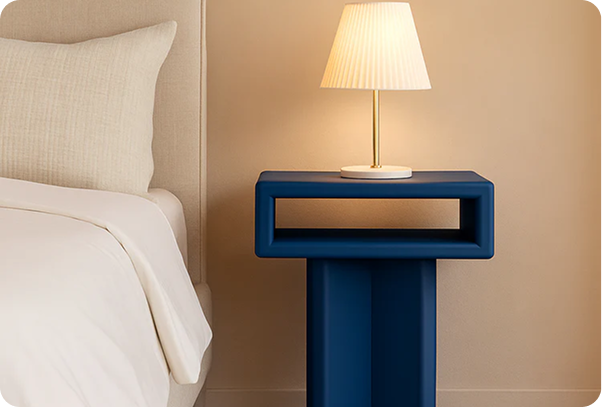
The Zeus is a 24-inch solid ashwood nightstand with a bold, sculptural silhouette. It is the piece for buyers in Vancouver’s Kitsilano, Toronto’s King West or Leslieville, or Montreal’s Griffintown who want the bedside table to be the visual anchor of the room - not a supporting player.
It is not about storage. It is about presence. The Zeus’s form is strong enough that a bare surface creates visual impact. A lamp, a book, a glass - and the Zeus carries the entire bedside.
Available in Dark Blue and Gray. The Dark Blue finish is particularly effective in minimalist white-and-neutral bedrooms common in Greater Vancouver apartments, Plateau-Mont-Royal flats, and downtown Toronto condos - where a single colour accent anchors an otherwise pared-back room.
Shop the Zeus Collection: ravloon.com/collections/zeus-simple-art-redefined
The Arrow is a 22-inch solid ashwood table with a boldly geometric silhouette. At 22 inches, it suits lower platform beds and modern frames - common in design-forward homes across Vancouver, Montreal, and Toronto’s downtown core.
It works beside a bed, beside a sofa, beside a lounge chair, in a reading corner, or as a surface on a balcony or sunroom. It is the piece that moves through different rooms and different life stages - from a rented apartment in Edmonton to an owned condo in downtown Vancouver - without ever looking like it does not belong.
Available in Off White and Gray.
Shop the Arrow Collection: ravloon.com/collections/arrow-true-geometry
|
Zeus |
Troy |
Arrow |
|
|---|---|---|---|
|
Height |
24 inches |
24 inches |
22 inches |
|
Best role |
Statement bedside table |
Substantial nightstand substitute |
Versatile end table and bedside |
|
Colours |
Dark Blue, Gray |
Off White, Gray |
Off White, Gray |
|
Construction weight |
Standard |
50 lbs (heavy-duty) |
Standard |
|
Best bed type |
Standard or queen frame |
Standard or queen frame |
Platform or low-profile frame |
|
Best suited to |
Vancouver condos, Montreal flats, Toronto design-forward homes |
Suburban GTA, Calgary, Edmonton, Ottawa houses |
All - especially multifunctional and compact spaces |
|
Price |
$319.99 (5% off $340) |
$339.99 (17% off $410) |
$400.00 |
The most common purchasing mistake is choosing a piece whose surface sits at the wrong height relative to the mattress. Reach too far down or too far up for your phone at 2am a few times and you will regret the choice every morning.
The practical rule: the surface of the piece beside your bed should sit within 2 to 3 inches of your mattress top - ideally level with it or just below.
For platform beds with a mattress top at 18 to 22 inches from the floor: the Arrow at 22 inches is the natural fit.
For standard bed frames with a box spring, where the mattress top typically sits at 24 to 26 inches: the Zeus and Troy at 24 inches align naturally with the mattress surface.
For taller beds or thick pillow-top mattresses where the mattress top exceeds 26 inches: add a lamp with a taller base beside the Zeus or Troy, which effectively raises the working height of the bedside without changing the table itself.
This guidance applies equally in Winnipeg and in Houston - the geometry of reaching for a glass of water in the dark is universal.
Whether you call it a nightstand, bedside table, or end table, the most consequential decision you will make is material - not what you call it.
The Canadian furniture market offers composite wood products at every price point. Here is what actually happens with those materials over time:
MDF and particleboard absorb moisture - especially in Canadian homes where indoor heating runs heavily through winter, creating low-humidity environments that make wood-based composites expand and contract repeatedly. Joints loosen within 2 to 4 years. Surface chips. Difficult to repair. Typical lifespan: 3 to 6 years.
Veneer over composite looks like real wood for the first year. Edges and corners begin to lift within 2 to 3 years, particularly in the humidity fluctuations common in Winnipeg, Edmonton, and Calgary bedrooms where winter air is very dry and summer air is humid.
Solid ashwood holds fasteners permanently, does not absorb moisture into its core structure, and develops natural character as the grain deepens over time. A well-maintained solid ashwood piece remains functional and visually relevant for 15 to 25 years.
Ravloon’s solid ashwood collections add a water splash-resistant coating - which addresses the one practical concern of natural wood in a bedroom: the glass of water knocked over at midnight.
The economics are straightforward. A Troy at $339.99 lasting 20 years costs $17 per year. A composite nightstand at $120 replaced every 4 years costs $30 per year - and you buy and assemble it five times over the same period.
The honest answer to “nightstand vs end table vs bedside table” is this: the category label matters far less than getting the height, the material, the proportions, and the design character right for your specific space.
A 24-inch solid ashwood piece with genuine visual presence and a water-resistant finish serves as a nightstand in a Brampton home, a bedside table in a Vancouver condo, and an end table in a Montreal apartment - and is exactly right in all three situations.
What matters is buying real material, right dimensions, honest craftsmanship, and a design that will not look dated in three years.
Ravloon’s Zeus, Troy, and Arrow collections are built for exactly that. Solid ashwood. Water splash-resistant finish. Fully assembled delivery. Free shipping across Canada - from Victoria to Halifax - and across the United States. Backed by a 30-day return policy and a 12-month limited warranty.
Explore all three collections at ravloon.com.
Q1. What is the actual difference between a nightstand and a bedside table?
A nightstand traditionally includes built-in storage - drawers, shelves, or a cabinet - and is designed primarily for function beside the bed. A bedside table is lighter in structure, usually with minimal or no storage, and is chosen primarily for design character and surface use. In modern Canadian homes, the two terms are often used for the same piece. Ravloon’s Zeus and Troy collections work as both, depending on how you use them.
Q2. Can an end table be used as a nightstand in Canada?
Yes - and this is standard practice in condos across Toronto, Vancouver, and Montreal. The key is height compatibility: the surface should sit within 2–3 inches of your mattress top. Ravloon’s Arrow Collection was designed specifically for this crossover use, marketed and used as a nightstand, end table, and side table.
Q3. What height should a nightstand or bedside table be?
The surface should be within 2–3 inches of your mattress top. For platform beds (mattress at 18–22 inches): the Ravloon Arrow at 22 inches is ideal. For standard frames with box springs (mattress at 24–26 inches): the Ravloon Zeus and Troy at 24 inches are the right fit. Getting this wrong is the most common furniture mistake in bedroom design.
Q4. What is the best material for a nightstand in Canadian climates?
Solid ashwood is the best choice for Canadian bedrooms, where indoor humidity fluctuates significantly with the seasons - particularly in Winnipeg, Edmonton, Calgary, and Ottawa. Unlike MDF or particleboard, solid ashwood does not absorb moisture and warp through seasonal humidity changes. Ravloon’s solid ashwood collections also carry a water splash-resistant coating for everyday bedroom durability.
Q5. Which Ravloon collection is best for a condo bedroom in Toronto, Vancouver, or Montreal?
The Zeus or Arrow are both well-suited to condo bedrooms. The Zeus (24 inches, Dark Blue or Gray) is the statement choice - bold enough to anchor a minimal room without taking up floor space. The Arrow (22 inches, Off White or Gray) is the versatile choice - proportioned for platform beds and compact enough to work in smaller rooms without creating visual clutter.
Q6. Are solid wood nightstands worth the price compared to cheaper options?
Yes - particularly when you calculate cost per year of use. A Ravloon Troy at $339.99 lasting 20 years costs $17 per year. A composite nightstand at $120 replaced every 4 years costs $30 per year and is replaced five times over the same period. For Canadian buyers done with the cycle of cheap furniture, solid ashwood is the economically smarter long-term decision.
Q7. How do I choose between the Ravloon Zeus, Troy, and Arrow collections?
Choose the Zeus if you want a bold design statement - a bedside piece that becomes the visual focal point. Choose the Troy if you want heavy-duty construction (50 lbs) with permanent presence - the closest to a traditional nightstand in solidity. Choose the Arrow if you want flexibility - a piece that works beside a platform bed today and beside a sofa next year.
Q8. Does Ravloon ship nightstands and end tables across all Canadian provinces?
Yes. Ravloon ships all collections free across Canada - including Ontario (Toronto, Mississauga, Brampton, Hamilton, Ottawa, London), British Columbia (Vancouver, Burnaby, Surrey, Richmond, Victoria, Kelowna), Quebec (Montreal, Laval, Quebec City, Gatineau), Alberta (Calgary, Edmonton, Red Deer), Manitoba (Winnipeg), Saskatchewan (Saskatoon, Regina), Nova Scotia (Halifax), and New Brunswick (Fredericton, Moncton). All orders ship fully assembled with a 30-day return policy and 12-month warranty. Ravloon also ships free across the United States.
Q9. What is the best bedside table for a small bedroom?
For bedrooms under 150 square feet - common in Toronto condos, Vancouver apartments, and Montreal flats - choose a piece with a compact footprint and an open or geometric base that preserves visual breathing room. The Ravloon Arrow (22 inches, geometric open form) is particularly well-suited to small bedroom configurations. Avoid pieces with closed solid sides, which visually compress an already compact room.
Q10. Does the difference between nightstand, end table, and bedside table matter when shopping?
Less than you think. Evaluate any piece by: height relative to your mattress, footprint relative to your floor space, material quality, and whether the design will age well. A well-made solid ashwood piece at the right height fits the role of nightstand, bedside table, or end table equally well - the label is irrelevant.
Ravloon is a Canadian furniture company based in Newmarket, Ontario, founded in 2021. The company designs and quality-checks solid ashwood nightstands, side tables, and end tables for modern homes across Canada and the United States - with free shipping, fully assembled delivery, and a 30-day return on all orders.


