
Cart
0
You may also like


 Deepak R Nair
Estimated read time: 8 minutes
Here is a question worth sitting with.
How long did you spend choosing your mattress?
Most Canadians spend weeks on it. They compare coil counts and foam densities, read Consumer Reports reviews, visit showrooms, and lie down in public places wearing their street clothes to test firmness levels. A 2020 Statistics Canada survey found that Canadian adults sleep an average of 7.9 hours per night - which means a Canadian who lives to 80 will spend roughly 26 years asleep. The mattress decision, accordingly, feels significant.
Now: how long did you spend choosing your nightstand?
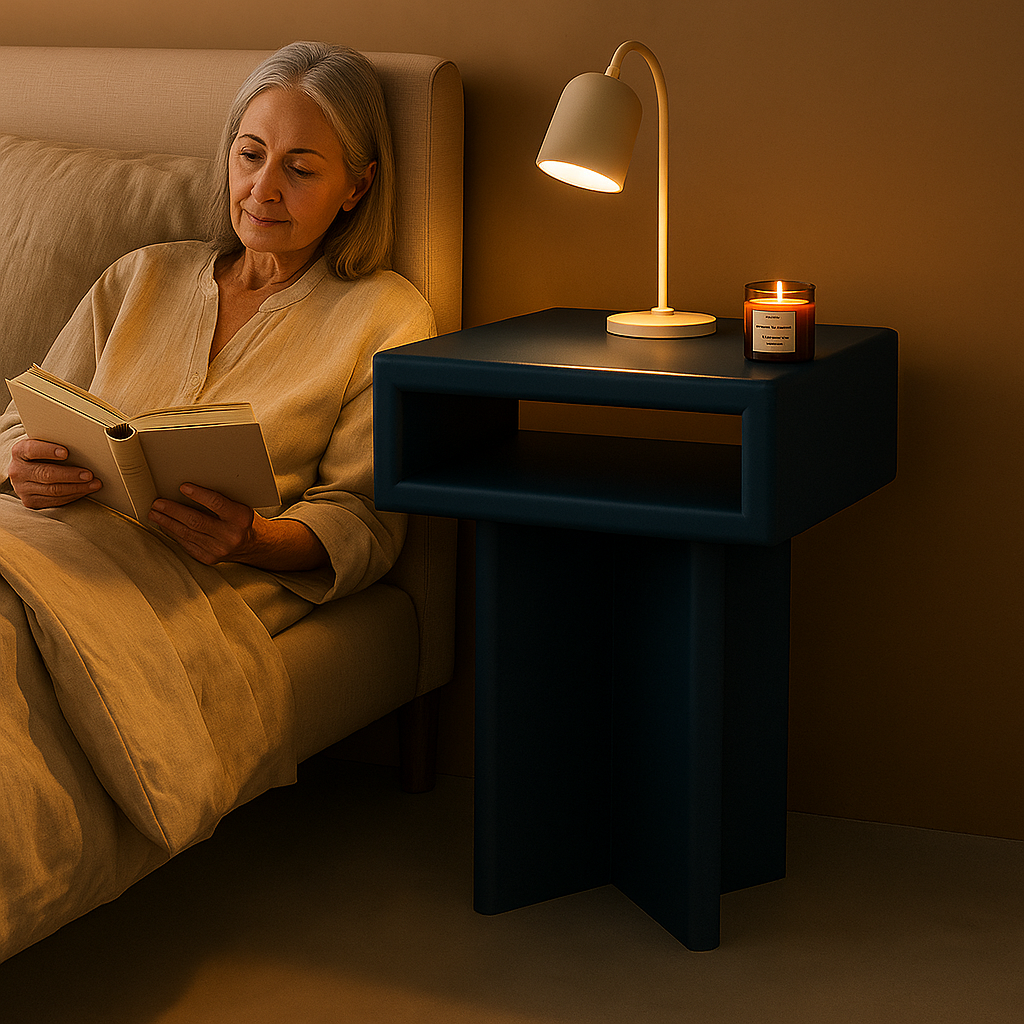
The piece sitting 18 inches from your face for those 26 years?
If you are like most homeowners across Toronto, Vancouver, Montreal, Calgary, Ottawa, and Halifax, the answer is some variation of: not very long. It might have arrived with a bedroom set. It might have been ordered in five minutes on a phone. It might have been inherited, or assembled at 11pm from a flat-pack box, or chosen specifically because it was cheap enough not to feel like a real decision.
And yet, consider what the nightstand actually does in a day.
You reach for it before you open your eyes. You place your phone on it before you close them. It holds your water, your medication, your reading glasses, your lamp, your books, your watch. According to Statistics Canada’s 2022 Time Use Survey, roughly 95% of Canadians are awake and active between noon and 8:25pm - but the nightstand is the only piece of furniture that also serves you in the other 15.75 hours.
The nightstand is the most used piece of furniture in the modern home. It is also, consistently, the most underestimated one.
That is a mistake worth correcting.
The Canadian home furniture market was valued at approximately $19 billion USD in 2024 and is projected to reach $23.5 billion by 2029, according to Research and Markets. Within that broader figure, bedroom furniture represented the largest single category - accounting for 30% of total home furniture market share in 2024, according to Mordor Intelligence’s Canada Home Furniture Market report.
That is not a coincidence. It is a reflection of how Canadians are thinking about their homes.
Several forces are converging simultaneously.
Urban density is changing bedroom expectations. Condominium development continues to dominate new housing stock in Toronto, Vancouver, and Montreal - and increasingly Calgary and Ottawa. According to Mordor Intelligence, developers are redesigning condo units to attract owner-occupants, and two-bedroom formats surged to 72% of new unit sales in Q4 2024. Smaller urban bedrooms demand furniture that works harder within less floor area.
The post-pandemic home has become the post-pandemic headquarters. Bedrooms in Canadian homes now serve more purposes than they did five years ago. Rest, relaxation, remote work, personal retreat - the bedroom has become a multi-functional space, and the furniture in it is being evaluated accordingly.
Millennials are leading a quality-over-quantity shift. According to Made in CA’s furniture industry statistics, Millennials buy the most furniture in Canada - and market trends show a clear preference for long-lasting, high-quality products over low-cost replacements. This generation is increasingly unwilling to buy furniture twice.

Wood is outperforming every other material category. Wood held a 40% material market share in the Canadian furniture market in 2024 - the largest of any single material category (Mordor Intelligence, 2024). As the broader push toward sustainable, durable, natural-material furnishing accelerates, that share is expected to grow.
Solid wood nightstands, bedside tables, and end tables are sitting at the intersection of every one of these forces.
One reason the nightstand is so frequently underestimated is because nobody agrees on what to call it.
Walk into a furniture store in Calgary and they will call it a nightstand. Ask a Montreal interior designer the same question and they will say table de chevet - bedside table. Search for one in Vancouver on a design platform and you will find the same piece listed as an end table, a side table, a nightstand, and a bedside cabinet, sometimes all at once.
These terms are related but not identical, and understanding the distinction helps buyers make better decisions.
A nightstand is bedroom-primary and storage-forward. The classic version has drawers or shelves designed to hold the full range of bedside essentials - medication, books, glasses, chargers. Height-wise, it typically sits at or just below mattress level, which for most queen or full-size beds means somewhere between 22 and 28 inches.
A bedside table occupies the same location but places greater emphasis on surface quality and design character than on storage. It tends to be more minimalist, often without drawers, chosen for what it looks like as much as what it holds. In modern Canadian bedrooms - particularly in design-forward markets like Vancouver’s Kitsilano and Toronto’s King West - bedside tables have largely overtaken traditional nightstands as the dominant format.
An end table was originally a living room piece, placed beside sofas and lounge chairs to hold drinks and remotes. Modern interior design has moved it decisively into the bedroom. Because end tables are proportioned for sofa arm heights (typically 20–26 inches), they often align naturally with contemporary platform beds - which is why designers across Canada and the US have been placing them at bedsides for years.
The practical lesson is this: the piece you are looking for - the surface beside your bed that improves your bedroom and your daily routine simultaneously - may be listed under any of these three names. What matters is not the label. It is the height, the material, the proportions, and whether the design will still look right in ten years.
Statistics Canada’s 2020 Canadian Community Health Survey found that 68% of Canadians aged 18 to 64 use electronic devices in the 30 minutes before falling asleep. That means 68% of Canadians are reaching for a phone, tablet, or device - and placing it somewhere beside the bed - immediately before they sleep.
That surface is the nightstand. And most people chose it with less thought than they gave their most recent streaming subscription.
The practical consequence of this inattention shows up quickly.
Most nightstands currently sold in the Canadian market are made from particleboard, MDF, or veneer-coated composite materials. These materials are inexpensive to manufacture and adequate for a year or two of use. But they have structural and environmental vulnerabilities that compound significantly over time - particularly in Canadian conditions.
Canada’s climate is not gentle on furniture. A bedroom in Edmonton or Winnipeg experiences dramatic indoor humidity swings between winter (very dry, with forced-air heating running continuously) and summer (more humid). A bedroom in Vancouver’s West End deals with persistent coastal moisture. A condo in downtown Toronto faces the thermal cycling of urban high-rise living. Particleboard and MDF absorb moisture and respond to it - expanding, contracting, swelling at edges, loosening at fasteners. What begins as a $120 nightstand that seemed perfectly acceptable frequently becomes a wobbly, surface-peeling problem within three to four years.
According to furniture industry data from James & James Furniture, most particleboard furniture lasts only five to ten years under normal household conditions - and the material’s composition makes meaningful repair impossible. Once damaged, particleboard requires complete replacement.
Solid wood responds to these same conditions differently. It adjusts to its environment over time. Its fasteners hold. Its surface, if scratched or worn, can be refinished. Quality solid wood furniture can last 20 to 50 years or more with proper care, according to the same industry analysis.
The cost-per-year arithmetic is straightforward. A particleboard nightstand at $120, replaced every four years, costs $30 per year and is purchased and assembled five times over a 20-year period. A solid wood nightstand at $340 used for 20 years costs $17 per year - and is never replaced.
There is a secondary reason the nightstand has become more consequential in modern Canadian bedrooms, and it is a design one.
Modern minimalism - the interior approach that has come to define contemporary Canadian home design from Toronto condos to Calgary townhomes - places an unusual demand on furniture. When rooms are stripped of excessive decoration, when surfaces are kept intentionally clear, when walls are left calm and unadorned, the furniture that remains becomes the entire visual language of the room.
In a traditional, heavily decorated bedroom, a mediocre nightstand disappears behind throw pillows, framed prints, and decorative objects. In a modern minimalist bedroom, the same nightstand is the most visible thing in the room at eye level.
This is why geometric furniture design has become increasingly significant. Bold silhouettes, architectural proportions, angular forms - these qualities create visual structure and depth in rooms that have deliberately removed everything that used to provide it. A nightstand with a strong geometric identity does the same compositional work that a gallery wall would do in a more decorated space. It does it without noise, and it does it permanently.
The National Sleep Foundation (NSF), in its framework for sleep-conducive bedroom environments, identifies visual clutter and environmental stress as factors that interfere with pre-sleep relaxation. A bedroom organized around a few well-chosen furniture pieces - rather than crowded with decorative objects - supports exactly the calm that good sleep requires.
The connection is more direct than it might appear: the furniture you choose for your bedroom affects how you feel in it, which affects how you sleep in it. Given that the average Canadian is sleeping approximately 7.9 hours per night (Statistics Canada, 2020 Canadian Community Health Survey), that is a significant downstream effect from what most people treat as a minor purchasing decision.
Ravloon is a Canadian furniture company based in Newmarket, Ontario, designing solid wood nightstands, bedside tables, and end tables since 2021. Every piece in the lineup is crafted from natural solid wood - not MDF, not particleboard, not veneer over composite - and finished with a water splash-resistant coating that handles the practical demands of real bedroom use in Canadian climates.
Three collections. Three distinct design characters. One material standard.
24 inches · Dark Blue or Gray
The Zeus is for the buyer who wants the furniture beside their bed to stop the room rather than disappear into it.
At 24 inches tall, it sits at standard mattress height for queen and full-size frames - the right surface level for the bedside routines of a typical Canadian adult sleeping 7.9 hours per night. Its sculptural silhouette creates immediate visual presence. The Dark Blue finish - applied over natural solid wood grain, so the wood texture remains visible beneath the colour - is the most distinctive finish in Ravloon’s lineup and has no direct equivalent in Canadian solid wood furniture at this price point.
Dark Blue Zeus beside a white or warm neutral bedroom: one piece, one decision, a room that looks entirely different from every other bedroom on the floor. The Gray Zeus for the same room result with a cooler, more understated tone.
With 39 verified customer reviews on the Dark Blue variant, the Zeus is Ravloon’s most reviewed collection.

24 inches · Off White or Gray
The Troy is for the buyer who wants the piece beside their bed to feel as permanent as the house itself.
At 50 pounds of solid ashwood construction, it is substantially heavier than most nightstands in its category. That weight is immediately perceptible when you place it - it does not shift, does not tip, does not feel temporary. For homeowners in suburban Calgary, Ottawa, the Toronto GTA, or Edmonton who want bedroom furniture that communicates permanence and quality, the Troy delivers that signal in both directions: visually and physically.
Off White is the finish to understand for modern Canadian bedroom design - a warm neutral (closer to RAL1013 than pure white) that integrates naturally into linen, cotton, and natural material rooms without competing. Gray is the cool-toned alternative, suited to charcoal, concrete, and matte-black palettes.
Currently at 17% off the regular price of $410.00 - the strongest current value in the lineup.

22 inches · Off White or Gray
The Arrow is Ravloon’s most strategically interesting piece because its design brief is genuinely unusual: one solid ashwood table that works as a nightstand, an end table, a side table, and a wine table - without compromising the design requirements of any of them.
At 22 inches, it is sized specifically for platform and low-profile bed frames - the format now dominant across urban Canadian condo bedrooms in Vancouver, Montreal, and downtown Toronto. The same 22-inch height aligns with lower contemporary sofa arm heights, making the Arrow equally useful beside a lounge chair or reading corner.
For buyers who move - from a rental in Saskatoon to an owned condo in Calgary, or from a Toronto apartment to a suburban home in Mississauga - the Arrow is the piece that does not require rethinking when the room changes. It follows.
Available in Off White and Gray, with the same solid ashwood and water splash-resistant construction as the other collections.

|
|
Zeus |
Troy |
Arrow |
|
Height |
24 inches |
24 inches |
22 inches |
|
Best role |
Statement bedside table |
Permanent nightstand |
Multi-room end table |
|
Colours |
Dark Blue, Gray |
Off White, Gray |
Off White, Gray |
|
Construction |
Standard solid ashwood |
50 lbs - heavy-duty |
Standard solid ashwood |
|
Best bed type |
Standard / queen |
Standard / queen |
Platform / low-profile |
All three: free shipping to every Canadian province and territory, and to all US states. Fully assembled delivery. 30-day return policy. 12-month limited warranty.
The underestimation of the nightstand is not a Canadian phenomenon. In the United States - home to the world’s largest furniture market - the pattern is identical.
American adults sleep an average of 7.2 hours per night, according to the National Sleep Foundation, spending more time interacting with their bedside surface than with most other furniture in their homes. The US furniture industry generates over $115 billion annually (Statista, 2024), yet nightstands and bedside tables remain among the most price-depressed categories within it - purchased more on convenience and cost than on quality and intention.
This is changing. The same Millennial-driven shift toward durability, natural materials, and considered purchasing that is reshaping the Canadian furniture market is operating in parallel across the US. Online and direct-to-consumer furniture channels - which Ravloon operates within - are projected to capture 35–40% of nightstand purchase volume by 2029, up from approximately 25% in 2024, according to IndexBox Canada Nightstand Wood Market analysis.
Ravloon ships free to all US states. The same solid ashwood collections available to a buyer in Winnipeg or Halifax are available to a buyer in Chicago, Seattle, or New York - with the same fully assembled delivery and 30-day return policy.
There is a quality that distinguishes great furniture from merely adequate furniture, and it is counterintuitive.
Great furniture eventually disappears.

Not because it lacks character. Because it works so well - the height feels right without thinking about it, the surface is always there when you reach for it, the material ages well enough that you stop worrying about it - that it integrates into daily life rather than demanding attention from it.
The National Sleep Foundation identifies the bedroom as the environment most directly connected to sleep quality, recovery, and daily wellbeing. The furniture in that environment - and specifically the piece at arm’s reach from the bed - is part of that environment in a way that is easy to underestimate from a furniture store or a product listing page, and obvious the moment you live with the right piece for a few weeks.
The nightstand is not a background item. It is the piece you interact with more than any other furniture in your home. It deserves a decision that reflects that.
Q1. What is the difference between a nightstand, a bedside table, and an end table?
A nightstand is traditionally the most storage-focused of the three - designed for bedroom use with drawers or shelves to hold daily bedside essentials. A bedside table occupies the same position but prioritizes design character and surface quality over storage, often without drawers. An end table was originally a living room piece beside sofas and chairs, but modern interior design - particularly in minimalist Canadian and US homes - has made it a standard bedside alternative. In practice, all three terms increasingly describe the same type of piece: a solid wood surface beside the bed at mattress height. What matters is the height, material, and design, not the name.
Q2. What height should a nightstand or bedside table be in relation to the bed?
The surface of a nightstand or bedside table should sit within 2–3 inches of the top of the mattress - either level with it or slightly below. For platform and low-profile beds, where the mattress top typically sits at 18–22 inches from the floor, Ravloon’s Arrow at 22 inches is the right fit. For standard bed frames with box springs, where mattress height typically reaches 24–26 inches, the Zeus and Troy at 24 inches align naturally. Getting this relationship right eliminates the awkward reaching that makes a bedside piece frustrating over time.
Q3. Why are solid wood nightstands better than MDF or particleboard alternatives in Canada?
Canadian homes experience significant indoor humidity fluctuations across seasons - especially in Winnipeg, Edmonton, Calgary, and Ottawa, where forced-air heating creates very dry winter conditions that shift to more humid summer air. MDF and particleboard absorb moisture and respond to it: expanding, swelling at edges, loosening at fasteners. Solid ashwood adjusts to its environment without structural degradation. Quality solid wood furniture can last 20–50 years, according to furniture industry analysis from James & James Furniture - versus 5–10 years for particleboard alternatives. Ravloon’s solid ashwood collections also carry a water splash-resistant coating applied over the natural wood surface, providing additional protection for real bedroom conditions.
Q4. How does Ravloon’s Zeus collection differ from Troy and Arrow?
Zeus (24 inches, Dark Blue or Gray, $319.99) is the statement bedside table - the collection chosen when one piece is meant to define the visual character of the room. Its Dark Blue finish is unique in Canadian solid wood furniture at this price point. Troy (24 inches, Off White or Gray, $339.99 - currently 17% off $410.00) is the permanent nightstand - 50-pound construction with a timeless geometric form, suited to buyers who want furniture that feels as solid as the room around it. Arrow (22 inches, Off White or Gray, $400.00) is the multi-room end table - designed to function as a nightstand, end table, side table, and wine table, and sized specifically for platform beds and lower sofa arms common in urban Canadian condos.
Q5. Does bedroom furniture actually affect sleep quality?
The evidence suggests the broader bedroom environment does. Research published in ScienceDirect (2023) identifies the bedroom as a space whose interior environment “directly affects sleep quality, which affects the quality of our lives and impacts productivity, health, and wellbeing.” The National Sleep Foundation’s framework for sleep-conducive environments specifically identifies visual clutter and environmental stressors as factors that interfere with pre-sleep relaxation. Statistics Canada’s 2020 Canadian Community Health Survey found that 68% of Canadians use electronic devices in the 30 minutes before sleeping - meaning most Canadians are interacting with their bedside surface in the minutes that most directly precede sleep. A well-designed nightstand at the right height, made from materials that age well and look right, contributes to the kind of calm, resolved bedroom environment the research consistently associates with better rest.
Q6. Is Ravloon’s solid wood furniture worth the price compared to cheaper alternatives?
Over time, yes - and the math is direct. A Troy at $339.99 lasting 20 years costs approximately $17 per year. A particleboard nightstand at $120 replaced every four years costs $30 per year and is purchased and assembled five times over the same period. Beyond the economics, particleboard furniture cannot be repaired when damaged - it requires full replacement. Solid ashwood can be refinished and restored. For Canadian buyers who have experienced the frustration of furniture that fails within a few years, solid wood represents the end of that cycle rather than another iteration of it.
Q7. Where can I buy solid wood nightstands and end tables in Canada?
Ravloon’s solid ashwood collections - Zeus, Troy, and Arrow - are available at ravloon.com with free shipping to every Canadian province and territory: Ontario (Toronto, Mississauga, Brampton, Ottawa, Hamilton, London, Kitchener, Windsor), British Columbia (Vancouver, Burnaby, Surrey, Richmond, Victoria, Kelowna, Abbotsford), Quebec (Montreal, Laval, Quebec City, Gatineau, Sherbrooke, Longueuil), Alberta (Calgary, Edmonton, Red Deer, Lethbridge), Saskatchewan (Saskatoon, Regina), Manitoba (Winnipeg, Brandon), Nova Scotia (Halifax, Sydney), New Brunswick (Moncton, Fredericton, Saint John), Newfoundland (St. John’s), Prince Edward Island (Charlottetown), and all territories. All orders arrive fully assembled with a 30-day return policy and 12-month limited warranty. Ravloon also ships free across the United States.
Q8. Can an end table be used as a nightstand or bedside table?
Yes - and this is increasingly standard practice in design-forward Canadian and US homes, particularly in the condo markets of Toronto, Vancouver, and Montreal. The key requirement is height compatibility: the surface should sit within 2–3 inches of mattress top. For platform beds at 18–22 inches, Ravloon’s Arrow at 22 inches is an ideal end table used as a nightstand. For buyers who want flexibility - a piece that serves as a nightstand in the bedroom and an end table in the living room as their home evolves - the Arrow is designed specifically for that multi-room versatility.
Ravloon is a Canadian furniture company based in Newmarket, Ontario. Founded in 2021, Ravloon designs and quality-checks solid ashwood nightstands, side tables, and end tables for modern homes across Canada and the United States - with free shipping, fully assembled delivery, and a 30-day return on every order.
References & Sources
Statistics Canada, 2020 Canadian Community Health Survey; Statistics Canada, 2022 Time Use Survey; Research and Markets, Canada Home Furniture Market 2024–2029; Mordor Intelligence, Canada Home Furniture Market Report 2024; IndexBox, Canada Nightstand Wood Market Analysis 2024; James & James Furniture, solid wood vs particleboard durability analysis; ScienceDirect, “Exploring the nexus between bedroom design and sleep quality,” 2023; National Sleep Foundation, sleep environment guidelines; Made in CA, Canada Furniture Industry Statistics 2025.


